From family mediation to commercial and civil mediation counselling.
Conflict- is, from the Latin, “to clash or engage in a fight,” and occurs when two or more individuals or groups pursue mutually incompatible goals. Conflict is viewed as a dynamic process in which structure, attitudes, and behaviour are constantly changing and influencing one another, (Johan Galtung). Symmetrical conflict-conflicts of interest between relatively similar parties such as a brother and sister, an employee and another employee, or two established governments. This is the most common form of conflict in society and the essence of the specialization of conflict and conflict management counselling. Violent or deadly conflict- similar to armed conflict but also includes one-sided, direct, physical violence such as genocides against unarmed civilians, (Ramsbotham).
Peace- As peace is a hypothetical construct; it is often easiest to define what peace is not that is, conflict. Negative peace – is the absence of direct violence and positive peace as the absence of all three forms of violence (direct, structural, and cultural). Direct violence is ended by changing conflict behaviour, structural violence is ended by removing structural contradictions and injustices, and cultural violence is ended by changing attitudes. These relate in turn to broader strategies of peacekeeping, peacebuilding, and peacemaking. Positive peace- the presence of social justice and equality, and the absence of structural or indirect violence; not only the absence of war but also absence of the instruments and the institutions of war, (Johan Galtung).
Conflict resolution- Where the deep-rooted source of conflict are addressed and transformed. The term is used to refer both to the process (or intention) to bring about changes and to the completion of the process. The aim of conflict resolution is not the elimination of conflict but rather to transform actually or potentially violent conflict into peaceful (non-violent) processes of social and political change, (Ramsbotham).
Peace & Conflict - Peace and conflict can take different forms, occurring on a number of levels with a wide variety of causes and outcomes. The two occur in various contexts, from the personal, family, school, and community levels to the international level ( Edu.Gov.com).
Ways of Managing Conflict (Source is Ramsbotham)- Peacekeeping- Refers to the interposition of international armed forces to separate the armed forces of belligerents. Peacemaking- The sense of moving towards the settlement of the armed conflict, where parties in conflict are induced to reach agreement voluntarily. Negotiation- The process whereby the parties within the conflict seek to settle or resolve their differences. Reconciliation- A longer-term process of overcoming hostility and mistrust between divided peoples. Restorative justice- Restorative justice involves active participation to work towards a peaceful resolution by those involved in a dispute or those responsible for or affected by a crime.
Preventing, Managing, and Resolving Conflict - It is important to remember that conflict is an inherent part of the human condition but that violent conflict can be prevented. There are a number of definitions and types of violence from the interpersonal to the global level (e.g. family violence, youth and gang violence, violence in the workplace, hate crimes, and war). Understanding the nature of violence may include discussion of social oppression, discrimination, and marginalization. Managing and resolving or transforming conflict can prevent the occurrence of violence.
“Each person has inside a basic decency and goodness. If he listens to it and acts on it, he is giving a great deal of what it is the world needs most. It is not complicated but it takes courage. It takes courage for a person to listen to his own goodness and act on it.” – Pablo Casals
Conflict resolution Mechanism
Mediation is a structured, interactive process where an impartial third party assists disputing parties in resolving conflict through the use of specialized communication and negotiation techniques. All participants in mediation are encouraged to actively participate in the process. Mediation is a "party-centred" process in that it is focused primarily upon the needs, rights, and interests of the parties,(Wikipedia).
A mediator – Mediator is a person who facilitates communication between the parties and helps the mediation participants reach a mutually satisfactory solution. The mediator is neither a judge nor an arbitrator - his/her role is not to decide the dispute that has arisen out between the parties. He/she must remain neutral and impartial (mediacja website).
Family Mediation Counselling- Family mediation services make the process as smooth as possible when it is clear that individuals must go their separate ways. The team available for legal mediators will assist couples to work through issues related to separation and divorce (including access, custody, support payments, division of property) in a peaceful, fair, and cost-effective manner. It is also used to solve family disputes, (Wikipedia).
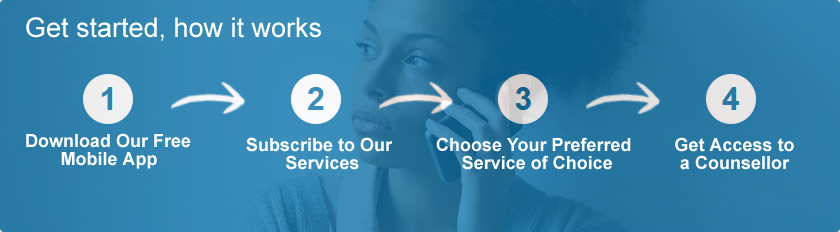
Commercial & Civil Mediation Counselling-Commercial and civil mediation counselling defuse tense or volatile situations in the working world or regarding interpersonal matters such as financial or property disputes. We link individual seeking businesses and civil disputants to accredited mediators to guide the process of resolving issues such as contractual disagreements, insurance claims, workplace disputes, wrongful dismissal, malpractice, motor vehicle accidents, estate disputes, interpersonal conflicts, landlord and tenants issues. Get the most suitable mediator for your situation in the Share with a Counsellor Mobile App.
Mediation techniques- The mediator uses a wide variety of techniques to guide the process in a constructive direction and to help the parties find their optimal solution. A mediator is facilitative in that she/he manages the interaction between parties and facilitates open communication. Mediation is also evaluative in that the mediator analyzes issues and relevant norms ("reality-testing"), while refraining from providing prescriptive advice to the parties (e.g., "You should do... .") (Wikipedia).
Alternative Dispute resolution: There are other ways of promoting peace and managing conflict between warring parties. Such include Arbitration, Conciliation, Mediation, Negotiation, Collaborative law, Conflict resolution, Dispute resolution, Lawyer supported mediation, Party-directed mediation and Restorative Justice.
Benefits of Meditation ( Source Benefit of Mediation July 2019 and Mediation.com)
- Cost- While a mediator may charge a fee comparable to that of an attorney, the mediation process generally takes much less time than moving a case through standard legal channels. While a case in the hands of a lawyer or a court may take months or years to resolve, mediation usually achieves a resolution in a matter of hours. Taking less time means expending less money on hourly fees and costs.
- Control- Mediation increases the control the parties have over the resolution. In a court case, the parties obtain a resolution, but control resides with the judge or jury. Often, a judge or jury cannot legally provide solutions that emerge in mediation. Thus, mediation is more likely to produce a result that is mutually agreeable for the parties.
- Compliance- Because the result is attained by the parties working together and is mutually agreeable, compliance with the mediated agreement is usually high. This further reduces costs, because the parties do not have to employ an attorney to force compliance with the agreement. The mediated agreement is, however, fully enforceable in a court of law.
- Mutuality- Parties to a mediation are typically ready to work mutually toward a resolution. In most circumstances the mere fact that parties are willing to mediate means that they are ready to "move" their position. The parties thus are more amenable to understanding the other party's side and work on underlying issues to the dispute. This has the added benefit of often preserving the relationship the parties had before the dispute.
- Support- Mediators are trained in working with difficult situations. The mediator acts as a neutral facilitator and guides the parties through the process. The mediator helps the parties think "outside of the box" for possible solutions to the dispute, broadening the range of possible solutions.
Accredited mediators- In May 2016, the Kenya Government established 'The Mediation Accreditation Committee (MAC) as a committee established under section 59A of the Civil Procedure Act (Chapter 21, Laws of Kenya). The register also forms a pool from which mediators are nominated and appointed to take part in the ongoing Court-Annexed Mediation Pilot Project. The mediators are selected from interested applicants who meet MAC- Accreditation set by the Committee. The process of accreditation is open and ongoing. Meaning the judicial system acknowledges the place of mediation in conflict resolutions and has a pool of accredited psychologist as mediation.
Share with a Counsellor Agency is here to support you on all conflict-related needs and counselling, you no longer need to wonder how to manage exiting conflicts. Most of the mediators also have other professional backgrounds like lawyers, psychologists and social workers, providing professionalism in the process. Linking you to a directory of Accredited Mediators will be a free service provided to the Share with a Counsellor Mobile Phone App subscribers. The Share with a Counsellor team understands that conflicts are part of the interaction and needs to be resolved as they occur.